Ancient insight
Read the New Testament movement alongside the early archaeological record.



AI-powered Missiological Strategy Assistant
Rooted in the early church.Attentive to today's communities.
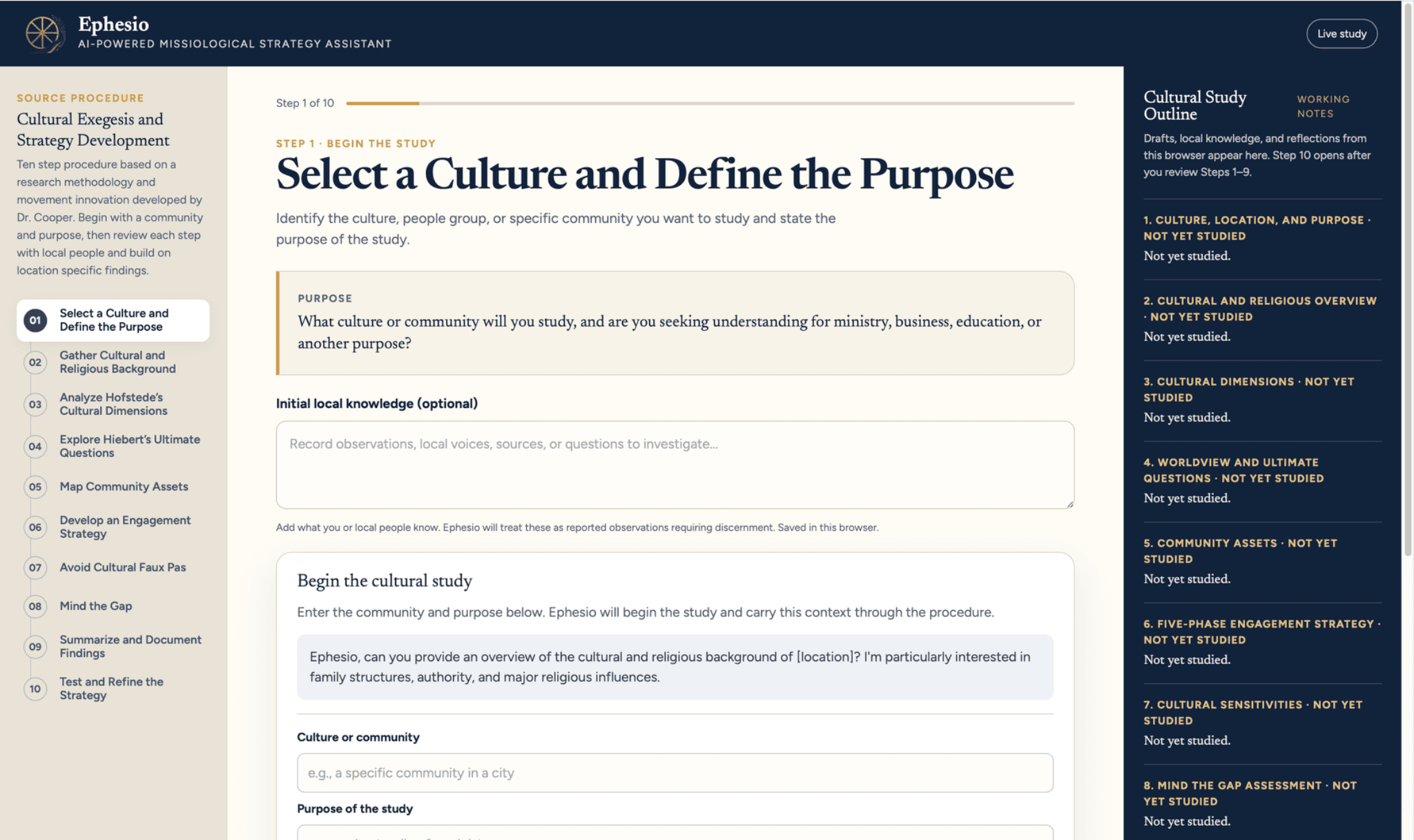
Ephesio is an AI-powered missiological strategy assistant that helps you study a community, reflect with others, and consider how to participate in God's mission.
Purpose
Ephesio brings cultural study, theological reflection, and the early Christian movement into conversation with the people and places of today.
Read the New Testament movement alongside the early archaeological record.
Attend to people, relationships, religion, and community assets.
Use Ephesio to organize questions and suggest possibilities to test locally.
Let study and theological reflection inform an adaptable strategy.
Discern where God may be at work and how to participate faithfully.
The Ephesio Journey
1.
Choose a specific community and purpose.
2.
Explore culture, worldview, and local strengths.
3.
Discuss findings with people and your team.
4.
Revisit assumptions in light of Scripture and archaeology.
5.
Listen for possibilities and act with local people.
6.
Bring field experience back to the strategy.
The research behind the process
Ephesio follows Dr. Cooper's 30 plus years of research experience focused on cultural engagement and strategy innovation. You can learn more about his process in Contemporary Druidry, Ephesiology, and Gods, Emperors, Philosophers, and a New Movement.
The tool offers working suggestions, not verified conclusions. Local voices, team reflection, and field experience help you discern where God may already be at work.
Begin a cultural study (opens the Ephesio app)Curiosity leads to discovery. Discovery invites reflection and wonder. Participation follows what we learn together.
Curiosity · Discovery · Reflection · Wonder · Participation
Built for practitioners and teams
The current Ephesio study is a place to begin, record local knowledge, and revisit your assumptions.
Begin with a community and the purpose of your study.
Add observations and corrections as the study develops.
Work through cultural, theological, and strategic questions.
Keep your responses and reflections together as you proceed.
Review the cultural study and sustainability assessment before field refinement.
Your study in one document
After Step 10, download your initial report as one PDF covering Steps 1–10, the local knowledge you add, your team self-assessment, and reflections. The complete report after Step 11 opens with an executive summary and introduces each step with a narrative summary before the detailed findings. Its length depends on the study. It brings cultural findings, strategic possibilities, and questions for personal or team reflection into one document.
View the illustrative report outline →The online sample illustrates the outline and excerpts. Ephesio's suggestions require local verification and prayerful reflection; Step 10 evaluates sustainability and indigeneity. Step 11 tests and refines the strategy through actual conversations and fieldwork.
Begin with a community. Listen and learn with others. Let what you discover reshape the strategy.
Open Ephesio (opens the Ephesio app)Paid studies are saved to your account and in your current browser.
EPHESIO
AI-powered Missiological Strategy Assistant
Developed by Dr. Michael T. Cooper
© 2026 Ephesio